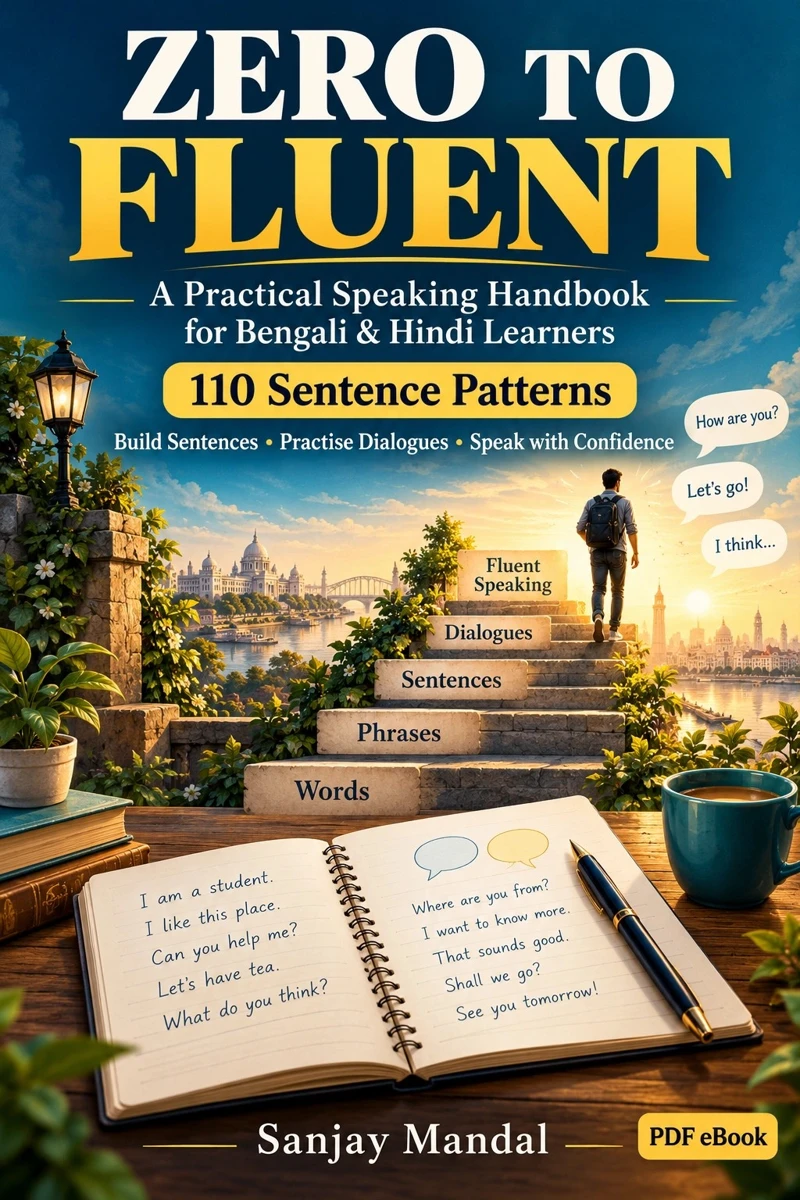
Sanjay Mandal · PDF eBook
Zero to Fluent
Master difficult sentence patterns: compare meanings, correct common mistakes and practise speaking.
Selected pages from the supplied manuscript. Free companion lessons below add explanations and practice; the full PDF is sold through Instamojo.
8 difficult topics · Indian English listening practice
Audio uses a synthetic Indian English voice, not the author's voice. Listen to the explanation, pause after each example, then repeat and make your own sentence.
Choose a lesson to begin.
1. Used to vs be used to
Book PDF pages 15–16 · companion practiceused to + base verb | be used to + noun / verb-ing
Used to describes a past habit or state. Be used to means accustomed to something; use a noun or an -ing form after it.
- I used to wake up late.আগে আমি দেরিতে ঘুম থেকে উঠতাম।
- Now I am used to waking up early.এখন আমি তাড়াতাড়ি ওঠায় অভ্যস্ত।
- She is getting used to speaking English.সে ইংরেজি বলায় অভ্যস্ত হয়ে উঠছে।
Common mistakeI am used to wake up early.
✓ I am used to waking up early.
Your turn
Complete: I used to ___. Now I am used to ___.
Read the audio transcript
Used to and be used to. Notice the difference. I used to wake up late. This describes a past habit. Now I am used to waking up early. This means that waking up early is familiar to me. After be used to, use the I N G form. Listen again. I used to wake up late. Now I am used to waking up early. She is getting used to speaking English. Getting used to means becoming accustomed to something. Your turn. Describe an old habit. Then describe something you are now used to doing.
2. Should have vs need not have
Book PDF pages 24, 30 · companion practiceshould have + V3 | need not have + V3 | did not need to + base verb
Should have can express an unfulfilled duty or regret. Need not have means the action happened but was unnecessary. Did not need to states there was no necessity; context tells us whether the action happened.
- You should have told me earlier.তোমার আমাকে আগে বলা উচিত ছিল।
- You need not have bought another notebook.আরেকটি খাতা কেনার প্রয়োজন ছিল না, কিন্তু তুমি কিনেছ।
- I did not need to buy a ticket because the journey was free.যাত্রা বিনামূল্যে হওয়ায় টিকিট কেনার প্রয়োজন ছিল না।
Common mistakeYou should have tell me.
✓ You should have told me.
Your turn
Say one regret and one unnecessary action using these patterns.
Read the audio transcript
Should have and need not have. You should have told me earlier. This expresses something that ought to have happened. Use the past participle after should have. Tell becomes told. Now listen. You need not have bought another notebook. You bought it, but it was unnecessary. Compare this with, I did not need to buy a ticket because the journey was free. There was no necessity. The context tells us whether a ticket was actually bought. Your turn. Say one thing you should have done. Then say one thing you did unnecessarily.
3. Make, get and have someone do something
Book PDF pages 35–36 · companion practicemake + person + base verb | get + person + to + verb | have + person + base verb
Make can mean compel; get can mean persuade or arrange; have can mean instruct or arrange for someone to do a task.
- The teacher made us rewrite the answer.শিক্ষক আমাদের উত্তরটি আবার লিখতে বাধ্য করলেন।
- I got my brother to help me.আমি ভাইকে আমাকে সাহায্য করতে রাজি করালাম।
- I had the mechanic check the brakes.আমি মেকানিককে দিয়ে ব্রেক পরীক্ষা করালাম।
Common mistakeThe teacher made us to rewrite the answer.
✓ The teacher made us rewrite the answer.
Your turn
Use make, get and have in three sentences about school or home.
Read the audio transcript
Make, get, and have. The teacher made us rewrite the answer. After make and a person, use the base verb. Do not add to. I got my brother to help me. After get and a person, use to and the base verb. I had the mechanic check the brakes. After have and a person, use the base verb. Listen to the contrast. Made us rewrite. Got my brother to help. Had the mechanic check. These patterns describe causing or arranging an action. Your turn. Make three sentences about getting something done at school or at home.
4. Have or get something done
Book PDF pages 37 · companion practicehave / get + object + V3
Focus on the thing receiving the action. This often means arranging for another person to do the work. Contrast repairing something yourself with having it repaired.
- I repaired my bicycle.আমি নিজে সাইকেল মেরামত করেছি।
- I had my bicycle repaired.আমি সাইকেল মেরামত করিয়েছি।
- She is getting her hair cut.সে চুল কাটাচ্ছে।
Common mistakeI had my bicycle repair.
✓ I had my bicycle repaired.
Your turn
Say what you had repaired, cleaned or painted.
Read the audio transcript
Have something done. I repaired my bicycle. This means I did the repair myself. I had my bicycle repaired. This usually means I arranged for someone else to repair it. The pattern is have, object, and past participle. I had my bicycle repaired. She is getting her hair cut. We had our classroom painted. Notice the object before the past participle. Bicycle repaired. Hair cut. Classroom painted. Your turn. Describe something you had repaired, cleaned, or painted. Make the meaning clear.
5. Second and third conditionals
Book PDF pages 49–50 · companion practiceIf + past form, would + verb | If + had + V3, would have + V3
The second conditional imagines a present or future situation. The third conditional imagines a different past. Match the condition and result to the meaning.
- If I had more time, I would practise every day.আমার আরও সময় থাকলে রোজ অনুশীলন করতাম।
- If I had studied harder, I would have passed.আরও পড়াশোনা করলে আমি পাস করতাম—কিন্তু তা হয়নি।
- If I were you, I would ask the teacher.আমি তোমার জায়গায় হলে শিক্ষককে জিজ্ঞাসা করতাম।
Common mistakeIf I would have studied harder, I would have passed.
✓ If I had studied harder, I would have passed.
Your turn
Make one imaginary present sentence and one different-past sentence.
Read the audio transcript
Second and third conditionals. If I had more time, I would practise every day. This imagines a different present situation. Now compare the past. If I had studied harder, I would have passed. This imagines a different past result. The condition uses had and the past participle. The result uses would have and the past participle. Listen again. If I had more time, I would practise. If I had studied harder, I would have passed. Your turn. Make one sentence about an imaginary present. Then make one about something you wish had happened differently.
6. Why to can be followed by verb-ing
Book PDF pages 63–64 · companion practicelook forward to + verb-ing | worth + verb-ing | no point in + verb-ing
Not every to is an infinitive marker. In look forward to, to is a preposition, so a following verb takes the -ing form.
- I am looking forward to meeting you.আপনার সঙ্গে দেখা করার জন্য সাগ্রহে অপেক্ষা করছি।
- This book is worth reading.বইটি পড়ার মতো।
- There is no point in arguing.তর্ক করে লাভ নেই।
Common mistakeI am looking forward to meet you.
✓ I am looking forward to meeting you.
Your turn
Say what you look forward to doing and what is worth learning.
Read the audio transcript
Why can to be followed by an I N G form? I am looking forward to meeting you. In look forward to, to is a preposition. Say meeting, not meet. Now listen to two more useful patterns. This book is worth reading. There is no point in arguing. Worth reading. No point in arguing. I am looking forward to attending the school sports. Your turn. Say what you are looking forward to doing. Then describe something that is worth learning. Notice the verb form each time.
7. No sooner had…than
Book PDF pages 64 · companion practiceNo sooner had + subject + V3 + than + subject + past verb
With No sooner at the beginning, invert had and the subject in this past-perfect pattern. Use than, not when. This is more formal than an ordinary everyday sentence.
- As soon as the teacher entered, we stood up.শিক্ষক ঢোকার সঙ্গে সঙ্গে আমরা উঠে দাঁড়ালাম।
- No sooner had the teacher entered than we stood up.শিক্ষক ঢুকতে না ঢুকতেই আমরা উঠে দাঁড়ালাম।
- No sooner had we reached the station than the train departed.আমরা স্টেশনে পৌঁছাতেই ট্রেন ছেড়ে দিল।
Common mistakeNo sooner had the teacher entered when we stood up.
✓ No sooner had the teacher entered than we stood up.
Your turn
Retell a quick sequence first with as soon as, then with no sooner.
Read the audio transcript
No sooner had, followed by than. As soon as the teacher entered, we stood up. A more formal version is, No sooner had the teacher entered than we stood up. Notice had before the subject. Notice than, not when. No sooner had we reached the station than the train departed. Reached and departed describe the two events. Your turn. Describe two events that happened in quick succession. First use as soon as. Then use no sooner had and than.
8. Question tags and short answers
Book PDF pages 72 · companion practicepositive statement → negative tag | negative statement → positive tag
Match the auxiliary and pronoun. With an ordinary present-tense verb use do or does; with a past-tense verb use did. Note the special tag aren't I after I am.
- You are ready, aren't you? Yes, I am.তুমি তৈরি, তাই না? হ্যাঁ।
- She does not like tea, does she? No, she does not.সে চা পছন্দ করে না, তাই তো? না, করে না।
- I am late, aren't I?আমি দেরি করেছি, তাই না?
- He went home, didn't he? Yes, he did.সে বাড়ি গেছে, তাই না? হ্যাঁ, গেছে।
Common mistakeHe went home, doesn't he?
✓ He went home, didn't he?
Your turn
Ask a partner three tag questions and give short answers.
Read the audio transcript
Question tags and short answers. You are ready, aren't you? Yes, I am. A positive statement usually takes a negative tag in this pattern. She does not like tea, does she? No, she does not. A negative statement takes a positive tag. Match the helping verb and the pronoun. Listen to the past tense. He went home, didn't he? Yes, he did. Finally, notice this special form. I am late, aren't I? Your turn. Ask a partner three tag questions. Answer with the correct helping verb.
These are selected challenging patterns from the book, with additional examples and teaching notes. Practise one pattern at a time and use it in your own conversation.
Printed edition & book detailsRead this book? Share your experience
Tell us what you thought after reading the book. Selected reviews may be published with your permission.